
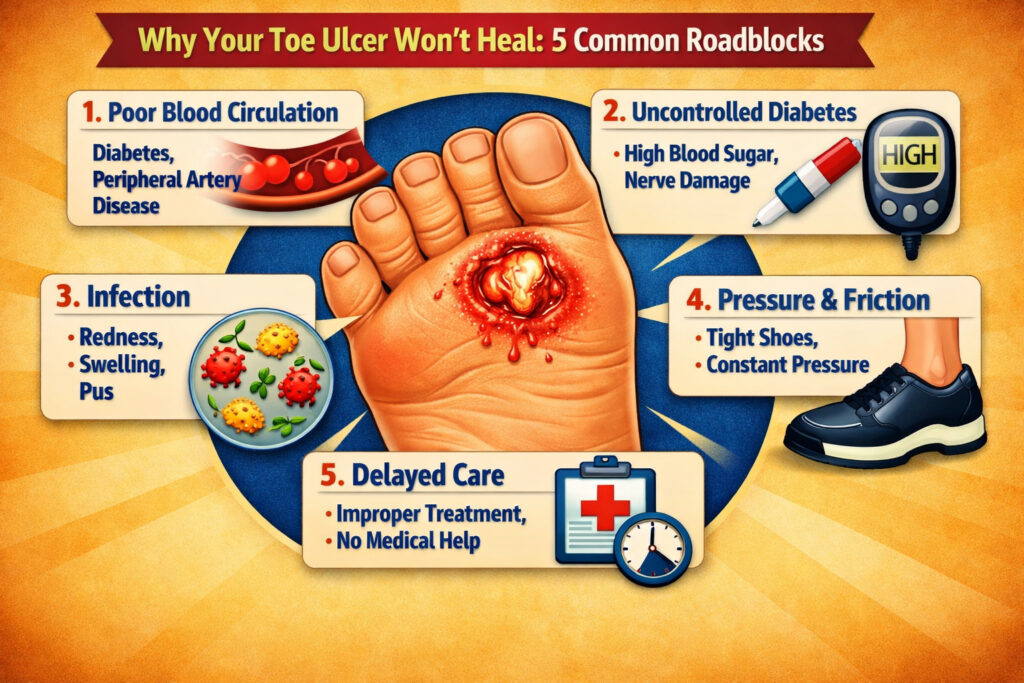
If you or someone you love has a toe ulcer that has been open for weeks — or even months — you are not alone. For millions of people living with diabetes in India, a small wound on the foot can turn into a persistent, frustrating battle. You change the dressing. You rest. You take the antibiotics. And still, the wound refuses to close.
This is not bad luck. There is a medical reason — usually more than one — why a diabetic toe ulcer stalls. Understanding those reasons is the first step toward real healing. In this article, we walk you through the five most common roadblocks that prevent toe ulcers from healing, and what a specialist can do to finally turn things around.
What Is a Diabetic Toe Ulcer and Why Is It Different from a Regular Wound?
A diabetic foot ulcer is an open sore or wound that most commonly appears on the bottom of the foot or on the toes. Unlike a cut or scrape in a healthy person, a diabetic ulcer does not follow the normal healing timeline because diabetes fundamentally changes how the body repairs itself.
How Diabetes Disrupts the Healing Process
High blood sugar over time damages the nerves (peripheral neuropathy) and narrows the small blood vessels (peripheral arterial disease) that supply oxygen and nutrients to the skin and deeper tissues. Without adequate blood flow and nerve signalling, even a tiny wound becomes a wound that cannot heal itself. White blood cells that fight infection move slowly. New skin cells form at a fraction of the normal rate. Proteins needed to rebuild tissue are depleted.
This is why a blister from a tight shoe, a small cut from a nail, or even a callus that breaks open can spiral into a serious ulcer in a diabetic patient — and why those ulcers need specialised, multi-layered care rather than simple home treatment.
When Should You Be Concerned?
A toe ulcer needs medical attention immediately if:
- The wound has been open for more than two weeks without visible improvement
- You notice redness, warmth, swelling, or discharge around the wound
- There is a foul smell coming from the wound
- You have fever, chills, or feel generally unwell
- The wound is deepening or the surrounding skin is turning dark
Do not wait. Delayed treatment is the single largest driver of preventable amputations in diabetic patients.
Roadblock 1 — Poor Blood Circulation to the Foot
Why Blood Flow Is the Foundation of Healing
Every healing process depends on blood. Oxygen, immune cells, growth factors, and nutrients all travel through blood vessels to the wound site. When the arteries supplying the foot are narrowed or blocked — a condition called peripheral arterial disease (PAD) — the wound is essentially starved.
PAD is extremely common in people with long-standing diabetes. In fact, many patients have significant arterial disease without knowing it because the nerve damage from diabetes also blunts the warning signal of pain (intermittent claudication). They feel no leg cramps, no burning — just a wound that will not close.
How Doctors Assess Circulation
A vascular assessment using the Ankle Brachial Index (ABI) and Doppler ultrasound can quickly identify how well blood is flowing to the foot. At Divyam – RDFC Visakhapatnam, every patient undergoes a thorough vascular evaluation as part of the initial workup — because treating a wound without addressing circulation is like watering a plant through concrete.
If significant blockage is found, the team coordinates with vascular specialists for interventions such as angioplasty or bypass procedures to restore flow. Only after blood supply is optimised can the wound begin to heal.
Roadblock 2 — Persistent or Hidden Infection
Infection Is the Silent Saboteur
A wound that is actively infected cannot heal. The immune system is too busy fighting bacteria to rebuild tissue, and the bacteria themselves produce enzymes that break down whatever new collagen the body manages to form. Many patients do not realise their wound is infected because nerve damage means they feel no pain — and the redness and swelling may be subtle.
Worse, some infections go deep. A toe ulcer can extend through the skin into the fat, tendons, and even bone — a condition called osteomyelitis. Bone infection requires prolonged antibiotic therapy and often surgical debridement or partial bone removal to resolve. If osteomyelitis is missed or under-treated, the ulcer will never fully close no matter what dressings are applied on the surface.
What Proper Infection Management Looks Like
Effective infection control involves:
- Wound swabs and bone biopsies to identify the exact bacteria (especially MRSA and multidrug-resistant organisms that are increasingly common)
- Targeted antibiotic therapy based on culture and sensitivity — not just broad-spectrum guessing
- Surgical debridement to remove all infected, dead, and devitalised tissue that blocks healing
- Advanced wound dressings with antimicrobial properties appropriate to the wound stage
At RDFC, Dr. Sumitra Gantayet — a reconstructive and plastic surgeon with specialised training in diabetic foot care — performs thorough debridement and tailors the treatment plan based on each patient’s wound biology.
Roadblock 3 — Uncontrolled Blood Sugar
You Cannot Out-Treat High Blood Sugar
This is one of the most frustrating truths about diabetic wound care: if blood glucose remains elevated, the wound will not heal — no matter how advanced the dressing, no matter how skilled the surgeon. High blood sugar impairs every phase of wound healing:
- Inflammation phase: White blood cells function poorly, so bacteria go unchecked
- Proliferative phase: Fibroblasts (the cells that build new tissue) are sluggish and produce weaker collagen
- Remodelling phase: The new scar tissue is fragile and prone to re-breakdown
A target HbA1c below 7% is generally recommended for optimal wound healing, but even short-term reductions in blood sugar during the treatment period can make a measurable difference.
Coordinating Wound Care with Diabetes Management
Wound care teams and diabetologists need to work together. At RDFC, patients receive guidance on integrating wound healing goals with their overall diabetes management — including medication adjustments, dietary counselling references, and monitoring protocols to track glucose trends during the healing journey.
Roadblock 4 — Pressure and Offloading Failure
Every Step You Take Damages the Wound
This is the roadblock that patients and even some treating doctors underestimate. The bottom of the foot is subjected to enormous mechanical force with every step. For a toe ulcer on a pressure point, walking without proper offloading is the equivalent of pressing on the wound hundreds of times a day. No wound can heal under constant mechanical trauma.
Diabetic neuropathy makes this worse. Because the patient cannot feel pain, they continue walking on the ulcer without realising the damage each step causes. The wound may look like it is improving on the surface while the deeper tissue is being crushed repeatedly.
What Effective Offloading Involves
True offloading is more than rest. It requires:
- Total contact casting (TCC): The gold standard for plantar foot ulcers, distributing weight evenly across the entire foot and limiting harmful shear forces
- Removable cast walkers and therapeutic footwear: For patients who cannot tolerate casting
- Offloading surgeries: When the bony anatomy itself is creating the pressure point — for example, a prominent metatarsal head or a Charcot deformity — surgical correction is the only permanent solution
Divyam-Reconstructive Diabetic Foot Care (RDFC) specialises in offloading surgeries: a complete biomechanical assessment of the foot identifies which structural abnormalities are driving ulceration, and targeted procedures reduce those pressures. This is what separates reconstructive diabetic foot care from simple wound dressing.
Roadblock 5 — Inappropriate or Inconsistent Wound Care
Not All Wounds Are the Same — and Not All Dressings Are Either
A very common reason toe ulcers stall is that they are being managed with the wrong type of dressing, or with the right dressing changed too infrequently — or too frequently. Wound care science has evolved dramatically. The days of dry gauze and iodine are over.
Modern wound management matches the dressing to the wound stage:
- Wet, exuding wounds need highly absorbent dressings (foam, alginate) that wick moisture away and prevent maceration of surrounding skin
- Dry, necrotic wounds need moisture-retentive dressings or enzymatic debriding agents that rehydrate dead tissue so it can be removed
- Infected wounds need antimicrobial dressings (silver, iodine-based, or PHMB) rather than standard gauze
- Granulating wounds near healing need gentle, non-adherent dressings that protect fragile new tissue
Using the wrong dressing can actively prevent healing — drying out a wound that needs moisture, or keeping a wound too wet and promoting fungal overgrowth.
The Role of Advanced Wound Care Technologies
Beyond dressings, evidence-based adjunctive therapies can dramatically accelerate healing in wounds that have stalled:
- Negative Pressure Wound Therapy (NPWT/VAC): Uses controlled vacuum to remove excess fluid, reduce bacterial load, and stimulate granulation tissue
- Skin grafting and flap reconstruction: When a wound is clean but too large to close on its own, plastic surgical techniques can provide permanent coverage — the specialty domain of Dr. Sumitra Gantayet at RDFC
- Platelet-rich plasma (PRP) and growth factor therapies: Emerging biologics that can re-ignite the healing cascade in chronic wounds
When Home Treatment Is Not Enough — What Specialist Care Looks Like
If your toe ulcer has been present for more than two to four weeks, or if it is getting larger or deeper rather than smaller, it is time to see a specialist — not just a general practitioner or a local pharmacy. A diabetic foot specialist brings together:
- Reconstructive surgery skills to address structural causes and provide tissue coverage
- Vascular assessment to ensure adequate blood flow
- Microbiology expertise to identify and treat the right organisms
- Biomechanical assessment to correct the pressure patterns driving the wound
- Long-term follow-up and preventive footwear prescription to stop recurrence
At Divyam – Reconstructive Diabetic Foot Care (RDFC) clinic in Visakhapatnam, led by Dr. Sumitra Gantayet (MBBS, DNB General Surgery, DrNB Plastic Surgery, BEOFFA Fellowship), the focus is on treating the whole patient — not just the wound. Every patient receives a personalised treatment plan that addresses circulation, infection, blood sugar, mechanical offloading, and the right wound care strategy simultaneously.
The clinic’s vision is clear: to be a beacon of hope for people with diabetes-related foot problems — empowering patients to heal, preserve their limbs, and live fully.
Preventing the Next Ulcer — Life After Healing
Healing a toe ulcer is a victory. Preventing the next one is the real goal. Research consistently shows that once a diabetic patient has had one foot ulcer, their risk of developing another within five years is high without proper preventive care.
Post-healing prevention includes:
- Regular foot examinations at a specialist clinic (at minimum every 3–6 months)
- Custom therapeutic footwear to redistribute pressure away from vulnerable areas
- Daily home foot inspections — checking for blisters, redness, cracks, or temperature changes
- Strict blood sugar control in partnership with your diabetologist
- Nail and callus care by a trained podiatrist or foot care specialist
- Lifelong patient education on footwear choices, hygiene, and early warning signs
RDFC provides structured post-operative and post-healing care protocols designed to keep patients wound-free long-term.
FAQS
1. How long does it take for a diabetic toe ulcer to heal?
With optimal treatment — good blood sugar control, proper offloading, infection management, and appropriate wound care — a straightforward superficial ulcer may heal in 6–12 weeks. Deeper or infected ulcers can take 3–6 months or longer. Wounds that have not shown improvement after 4 weeks of correct treatment should be reassessed for underlying roadblocks like vascular disease or bone infection.
2. Can a toe ulcer heal without surgery?
Many toe ulcers heal with conservative management: debridement, dressings, offloading, and systemic treatment. However, ulcers caused by structural bony pressure points, those with osteomyelitis, or those that are too large to close on their own will need surgical intervention. Reconstructive procedures — including skin grafts, flaps, and offloading surgeries — can achieve wound closure when conservative care cannot.
3. Is it normal for a diabetic ulcer to smell?
A foul-smelling ulcer is a red flag for bacterial infection, particularly with anaerobic organisms or pseudomonas. It should never be dismissed as “normal.” Infected wounds need urgent medical assessment, proper wound swabs, targeted antibiotics, and often surgical debridement. See a specialist promptly if your wound has an odour.
4. What happens if a toe ulcer is left untreated?
Untreated diabetic toe ulcers can progress rapidly. Infection can spread to bone (osteomyelitis), then to the foot (necrotising fasciitis or wet gangrene), requiring partial or complete amputation of the toe, foot, or even the lower limb. Diabetic foot complications are the leading cause of non-traumatic lower limb amputations worldwide. Early specialist care is essential.
5. Is RDFC in Visakhapatnam good for diabetic foot ulcers?
Divyam – RDFC (Reconstructive Diabetic Foot Care) in Visakhapatnam is led by Dr. Sumitra Gantayet, a reconstructive and plastic surgeon with specialised training in diabetic foot care including a BEOFFA fellowship and membership in the Diabetic Foot Society of India. The clinic offers comprehensive care including vascular assessment, advanced wound care, offloading surgeries, reconstructive surgery, and long-term preventive protocols — all under one roof. You can reach them at +91 88867 35004 or visit rdfc.in.
Ready to Break Through the Roadblock? Take the Next Step.
A toe ulcer that won’t heal is not something you have to live with — and it is certainly not something to ignore until it becomes a crisis. The right specialist care, at the right time, can mean the difference between healing and amputation.
At Divyam RDFC Visakhapatnam, we are here to help.
Dr. Sumitra Gantayet and the Divyam – RDFC team offer a complete assessment of your foot, your wound, and your overall condition — and build a personalised plan that treats the root cause, not just the surface.
📞 Call us now: +91 88867 35004
📍 2nd Floor, Coastal One, Plot No. 1, Balaji Nagar, Siripuram, Visakhapatnam 530003
🌐 Book online: rdfc.in/contact/
Emergency care is available 24/7 for urgent diabetic foot complications. Don’t wait — call us today.