
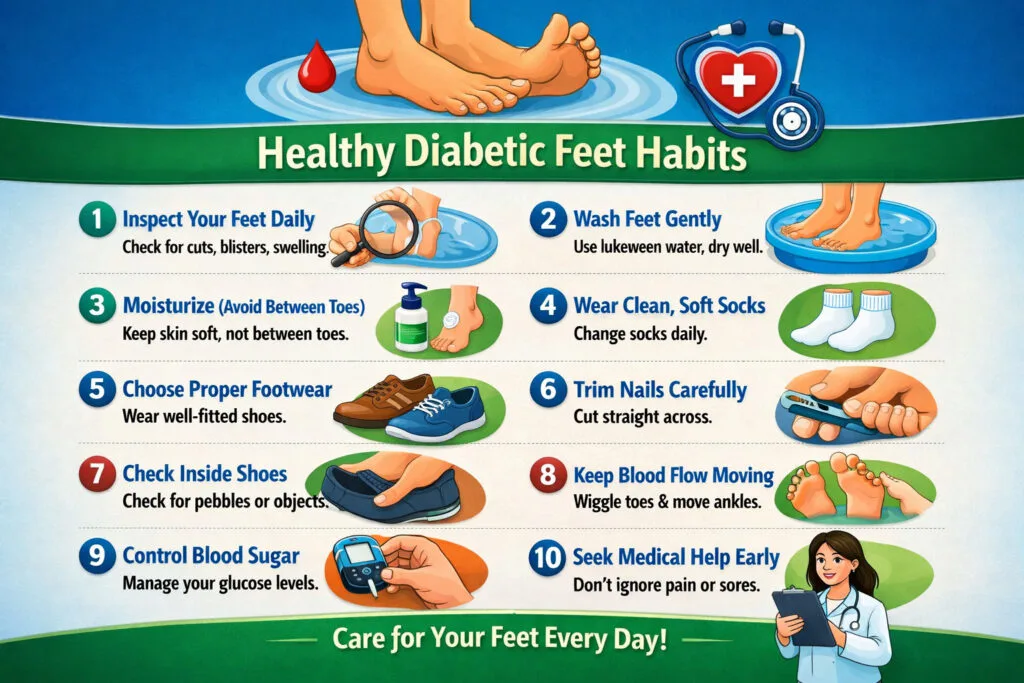
10 Daily Habits That Could Save Your Feet
If you’re living with diabetes, your feet deserve special attention every single day. High blood sugar levels can damage nerves and reduce blood flow to your feet, making even small cuts or blisters turn into serious complications if left unchecked. The good news? With a few consistent daily habits, you can dramatically lower your risk of infections, ulcers, and even amputation.
Why Daily Foot Care Is Non-Negotiable for Diabetics
Diabetes affects the feet through two primary mechanisms:
Diabetic peripheral neuropathy — nerve damage that dulls sensation, meaning you may not feel a wound, pressure sore, or foreign object inside your shoe.
Peripheral arterial disease (PAD) — poor blood circulation to the feet, which slows healing and makes infections harder for your body to fight.
Together, these two conditions form a dangerous combination. A wound that a healthy person heals in days can take weeks or months in a diabetic patient — and without proper care, it can become infected, gangrenous, or require surgical intervention.
This is why diabetic foot care isn’t optional. It’s a daily medical necessity.
Habit 1: Inspect Your Feet Every Morning and Evening
This is the single most important habit you can build.
Because neuropathy reduces pain sensation, you could have a cut, blister, redness, or ulcer forming and feel absolutely nothing. Daily inspection catches problems before they escalate.
How to do it correctly:
- Sit in good light, or use a well-lit mirror to see the soles
- Check between every toe — fungal infections and small wounds hide there
- Look for redness, swelling, skin discoloration, or any break in the skin
- Feel gently for warmth, which can signal early infection
- Note any change in nail colour, shape, or odour
If you cannot see the soles of your feet clearly due to limited mobility, ask a family member or caregiver to help. At RDFC Vizag, patients are taught structured foot inspection techniques during their preventive care consultations — our preventive care services here.
Habit 2: Wash Your Feet Daily — With the Right Temperature
Daily washing removes bacteria, sweat, and debris that can cause infection. However, because neuropathy affects temperature sensitivity, many diabetic patients unknowingly wash their feet with water that is far too hot — causing burns they cannot feel.
Safe washing protocol:
- Always test water temperature with your elbow or wrist, not your foot
- Use lukewarm water (around 37°C / body temperature)
- Use a mild, non-perfumed soap
- Wash gently, paying special attention to the spaces between toes
- Keep soaking time brief — no more than 3–5 minutes. Prolonged soaking softens skin and increases vulnerability to cuts and infection
Dry carefully. Pat feet dry with a soft towel — never rub. Pay close attention to between the toes, as retained moisture is a prime environment for fungal growth.
Habit 3: Moisturise Daily — But Not Between the Toes
Diabetic skin tends to be dry and prone to cracking, especially at the heels. Cracks in the skin — even shallow ones — are entry points for bacteria.
Apply a good quality foot cream or fragrance-free moisturiser to the tops and soles of your feet every day, ideally right after washing when the skin is still slightly damp and absorption is best.
Important: Do NOT apply moisturiser between your toes. The spaces between toes already retain moisture naturally; adding cream there increases the risk of fungal infections like athlete’s foot.
If you notice deep heel cracks that bleed or don’t heal, book an appointment with a diabetic foot specialist. This may require medical-grade treatment, not just cream.
Habit 4: Never Walk Barefoot — Not Even Inside the House
This habit surprises many patients, but the risk is real. Walking barefoot — indoors or outdoors — exposes the feet to:
- Sharp objects (a fallen pin, a piece of broken tile, a glass shard)
- Hot surfaces (floor tiles heated by afternoon sun)
- Pressure points and friction that create calluses and sores
Because neuropathy may prevent you from feeling these injuries, you may walk on a wound for hours without realising it.
What to do instead:
- Wear well-fitted, closed-toe footwear every time you stand up
- At home, use clean indoor diabetic-friendly slippers with a soft, protective sole
- Never wear sandals or open-toed shoes as your primary diabetic footwear
- Shake shoes before wearing them — check for pebbles or any object inside
Habit 5: Choose and Check Your Footwear Every Single Day
Poorly fitted footwear is one of the leading causes of diabetic foot ulcers. Tight shoes create friction and pressure; loose shoes allow the foot to slide, causing blisters.
Diabetic footwear guidelines:
- Buy shoes in the afternoon when feet are naturally at their largest
- Choose footwear with a wide toe box — toes should not be compressed
- Look for cushioned soles and seamless interiors (seams rub and cause blisters)
- Avoid high heels, pointed toes, and plastic materials that don’t breathe
- Replace worn footwear promptly — a compressed sole no longer protects
Before wearing your shoes, run your hand inside to check for any foreign objects, rough seams, or debris. Do this every single day. This 10-second check has prevented countless amputations.
Patients at Divyam RDFC receive a plantar pressure assessment to identify exactly which areas of their foot bear excess weight — this data guides personalised footwear recommendations
Habit 6: Cut Toenails Carefully and Correctly
Improper nail trimming is a surprisingly common cause of diabetic foot wounds. Cutting nails too short, rounding the corners aggressively, or using sharp instruments carelessly can cause small cuts that turn into serious ulcers.
Safe nail care for diabetics:
- Cut nails straight across — never curve them at the corners (curved cuts cause ingrown toenails)
- Use nail clippers, not scissors, for better control
- File any sharp edges with a soft emery board
- Cut nails after washing when they are softer
- Never cut calluses or hardened skin yourself — this is a job for a medical professional
If your nails are thick, discoloured, or difficult to cut, or if you have reduced sensation in your hands, do not attempt to cut them yourself. Visit a podiatrist or diabetic foot clinic where safe nail care is part of routine treatment.
Habit 7: Manage Your Blood Sugar — It Directly Impacts Your Feet
This may seem obvious, but it bears repeating: your feet heal at the speed your blood sugar allows.
Chronically elevated blood glucose damages blood vessels (reducing oxygen delivery to wound sites) and worsens nerve damage. Even a small wound in a patient with well-controlled blood sugar heals far faster than the same wound in a patient with HbA1c above 9%.
Daily blood sugar habits that protect your feet:
- Monitor blood glucose as advised by your endocrinologist
- Take insulin or oral medications consistently — don’t skip doses
- Follow a balanced, low-glycaemic diet (consult a diabetologist or dietitian)
- Avoid prolonged sitting — short walks improve peripheral circulation
- Stay hydrated — dehydration thickens blood and worsens circulation
Blood sugar control is one of the most powerful systemic tools against diabetic foot complications. It complements every other habit on this list.
Habit 8: Do Gentle Foot Exercises Daily
Poor circulation is a core problem in diabetic feet. Simple, gentle exercises performed daily improve blood flow to the lower extremities and keep the joints mobile.
Exercises you can do while sitting:
- Ankle circles: Rotate each ankle clockwise and counterclockwise, 10 times each
- Toe raises: While seated, lift your toes upward, hold for 3 seconds, release. Repeat 10 times
- Heel raises: Lift heels off the floor while keeping toes down. Hold and release. Repeat 10 times
- Towel scrunches: Place a small towel on the floor and scrunch it with your toes — excellent for circulation and toe muscle strength
If you are cleared for walking by your doctor, a 20–30 minute flat-surface walk daily is one of the best things you can do for your circulatory health. Avoid high-impact exercises that put excessive pressure on the feet.
Habit 9: Keep Your Feet Warm — But Never Use a Hot Water Bottle
Diabetes often causes feet to feel cold due to reduced blood flow. The instinct is to warm them with a hot water bottle or heating pad — but this is dangerous.
Because neuropathy impairs sensation, patients frequently burn their feet on heat sources they cannot feel. These burns can become severe wounds.
Safe ways to keep feet warm:
- Wear clean, dry, well-fitting woollen or thermal socks (without tight elastic bands that restrict circulation)
- Keep the home warm in colder months
- Avoid sitting with feet close to a fireplace or heater
- Never use hot water bottles, electric blankets on the feet, or heating pads directly on the skin
Check socks for tight bands at the calf or ankle — these act like tourniquets on already compromised circulation.
Habit 10: Report Any Change to Your Doctor Immediately — Don’t Wait
This is where many patients lose the battle: they notice something — a small sore, a blister that isn’t healing, an area of redness — and decide to wait and watch.
In diabetic foot care, waiting is the most dangerous choice you can make.
A wound that looks minor can become infected within 24–48 hours. An infection in a diabetic foot can spread rapidly to bone (osteomyelitis). By the time pain sets in — if it sets in at all — the wound may already require surgical intervention.
When to seek immediate attention:
- Any wound, cut, or blister that hasn’t healed in 2–3 days
- Redness, warmth, or swelling around a wound
- Any discharge from the skin — clear, cloudy, or bloody
- A darkening or blackening patch of skin (this can indicate gangrene)
- Sudden increase in foot odour
- Fever alongside a foot wound (sign of systemic infection)
At Divyam – Reconstractive Diabetic Foot Care (RDFC), emergency diabetic foot care is available 24/7. Call +91 88867 35004 if you notice any of the above. Early intervention is the difference between a wound that heals and one that becomes a surgical emergency.
A Day-in-the-Life: What Diabetic Foot Care Actually Looks Like
Here is what following all 10 habits looks like in a practical daily routine:
| Time | Habit |
|---|---|
| Morning | Inspect feet thoroughly, wash in lukewarm water, dry completely |
| After washing | Apply moisturiser (avoiding between toes) |
| Before shoes | Run hand inside footwear, check for debris |
| Throughout day | Never walk barefoot, wear diabetic-friendly footwear |
| During breaks | Do seated ankle and toe exercises |
| Evening | Re-inspect feet for any new changes |
| Night | Wear warm socks if needed, never use hot water bottle |
| Daily | Take medications, monitor blood sugar |
| Weekly | Trim nails straight across, check footwear for wear |
| Any time | Report wounds or changes to your doctor immediately |
When Home Care Isn’t Enough: Signs You Need a Specialist
Daily habits are powerful — but they are prevention, not treatment. If you already have a wound, an infection, persistent swelling, or unexplained skin changes, you need expert medical assessment.
At Divyam Reconstructive Diabetic Foot Care Clinic in Visakhapatnam, Dr. Sumitra Gantayet and her team offer:
- Comprehensive foot examination — assessing structure, sensation, and circulation
- Advanced wound care — specialised dressings and debridement protocols tailored to each wound
- Infection control — targeted antibiotic therapy and surgical debridement where needed
- Vascular assessment — ABI measurements and blood flow evaluation to understand healing capacity
- Plantar pressure assessment — identifying high-risk pressure points before ulcers form
- Reconstructive surgery — skin grafts, flaps, and microsurgery for complex cases
- Offloading surgeries — surgical correction of foot deformities that create dangerous pressure points
- Sensory testing — detailed nerve function evaluation
- Post-operative and lifelong care — because prevention never stops after surgery
FAQs
1. How often should a diabetic person get a professional foot check?
Every person with diabetes should have a professional foot examination at least once a year — and more frequently if they already have neuropathy, poor circulation, a history of ulcers, or active wounds. , we recommend scheduling a preventive foot assessment every 6 months for high-risk patients.
2. Can diabetic foot problems be completely prevented?
Many diabetic foot complications can be significantly delayed or prevented through consistent daily care, well-controlled blood sugar, and regular professional check-ups. Some complications — particularly in patients with long-standing, poorly controlled diabetes — may still occur despite good care, but their severity and progression can be managed with early intervention.
3. Are diabetic socks really necessary, or is it just marketing?
Purpose-designed diabetic socks are not a gimmick — they serve important clinical functions. They are made without constricting elastic bands, have moisture-wicking properties to keep skin dry, are cushioned to reduce pressure, and are often seamless to prevent friction wounds. They are a worthwhile investment for anyone with diabetic neuropathy.
4. I have no pain in my feet. Does that mean they are healthy?
Not necessarily — and this is the most dangerous misconception in diabetic foot care. Absence of pain in a diabetic foot often signals neuropathy (nerve damage), not health. A foot with no sensation can harbour a serious wound, deep infection, or structural deformity without the patient feeling anything. Regular visual inspection and professional assessment are essential even when the feet feel “fine.”
5. My wound has been there for two weeks. Is it too late to see a doctor?
No — it is never too late to seek help, but every day matters. A two-week-old wound in a diabetic patient carries a higher risk of deep infection or osteomyelitis (bone infection) than a fresh wound. Seek specialist care immediately. Dr. Sumitra Gantayet’s team at RDFC has successfully managed complex, long-standing wounds — early assessment always improves outcomes.
Conclusion
Living with diabetes means living with a higher baseline risk to your feet. But it also means you have the power to dramatically reduce that risk — through daily, consistent, simple actions.
Inspect. Wash. Moisturise. Wear the right shoes. Manage your blood sugar. Move your feet. Stay warm safely. Report problems immediately.
These 10 habits cost you nothing but a few minutes each day. What they protect is everything: your mobility, your independence, your quality of life.
If you are in Visakhapatnam and concerned about your diabetic foot health, don’t wait for a problem to get serious. Book a preventive consultation with Dr. Sumitra Gantayet at Divyam Reconstructive Diabetic Foot Care Clinic today.
📍 Divyam RDFC — 2nd Floor, Coastal One, Plot No. 1, Balaji Nagar, Siripuram, Visakhapatnam 530003
📞 +91 88867 35004 | Emergency care available 24/7
🌐 www.rdfc.in | Book a Consultation