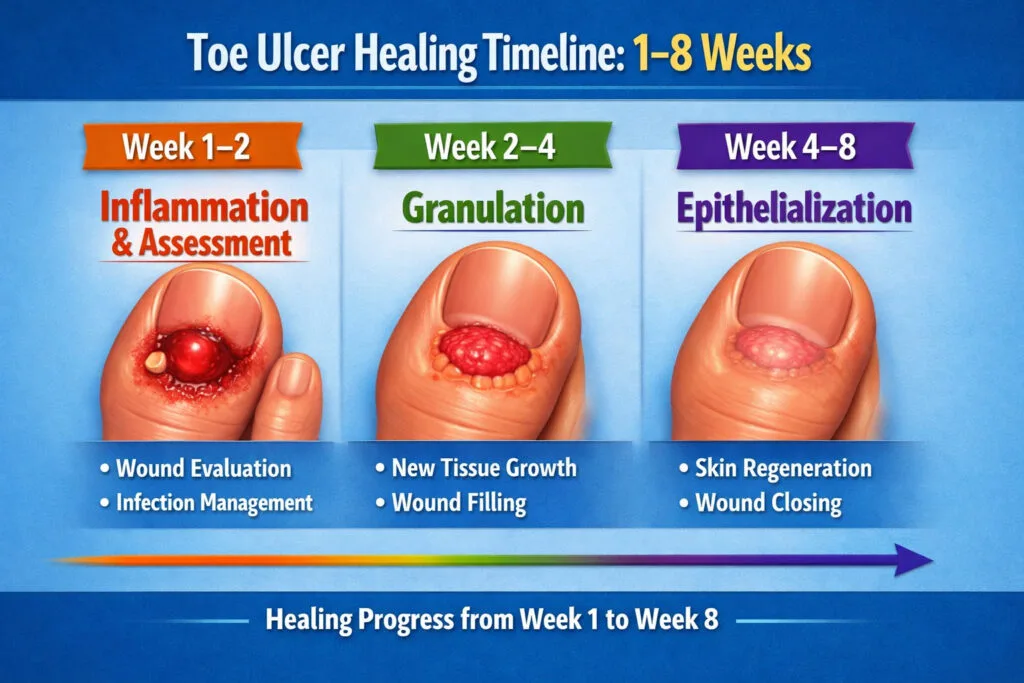
Most uncomplicated toe ulcers heal in 4 to 8 weeks with proper wound care, offloading, and infection control. But if you have diabetes, poor circulation, or nerve damage, healing can stretch to 3 months or longer — and some wounds never close without medical intervention. The exact timeline depends on the ulcer’s depth, blood supply to the foot, blood sugar control, and how quickly treatment begins. If your toe ulcer hasn’t shown visible improvement within two weeks, it’s a sign to see a foot specialist rather than wait it out.
A toe ulcer might look like a small, harmless sore — but for anyone with diabetes, it’s one of the most important wounds on the body to take seriously. Below, we break down exactly what affects healing time, what a normal recovery looks like week by week, and what can turn a simple ulcer into a limb-threatening complication.
Why Toe Ulcers Take Longer to Heal Than Other Wounds
Toes sit at the very end of the body’s circulatory system. Blood has to travel the farthest to reach them, which means even a mild reduction in circulation — common in diabetes, smoking, or peripheral artery disease — shows up first and worst in the toes. Add constant pressure from footwear, friction, and moisture, and toe wounds face more obstacles to closing than an ulcer on, say, the thigh or forearm.
For people without diabetes, a minor toe wound often heals in one to two weeks. For people with diabetes, the same wound can take three to four times longer, because high blood sugar interferes with the body’s ability to fight infection, build new blood vessels, and produce collagen — all essential steps in wound repair.
The Typical Toe Ulcer Healing Timeline
Every ulcer is different, but a reasonably well-managed toe ulcer generally follows this pattern:
Week 1–2: Inflammation and Assessment
The wound is cleaned, dead tissue is removed if needed, and the cause of the ulcer (poor circulation, pressure, or nerve damage) is identified. Swelling and mild discharge are normal here — but the wound should not be getting bigger, deeper, or more painful during this stage. This is also when your doctor may recommend imaging or a vascular check to rule out poor blood flow, similar to the assessment used for a plantar ulcer.
Week 2–4: Granulation
Healthy wounds start forming new, pink-red tissue (granulation tissue) at the base of the ulcer. The wound bed should look moist and beefy-red, not yellow, black, or foul-smelling. Offloading — keeping weight and pressure off the toe — is critical during this phase, since repeated pressure reopens the wound before it can properly close.
Week 4–8: Epithelialization
New skin begins to grow inward from the wound edges. The ulcer visibly shrinks in size week by week. Most shallow, well-managed ulcers reach full closure somewhere in this window.
Beyond 8 Weeks: Chronic or Complicated Ulcers
If a toe ulcer hasn’t significantly reduced in size after 4 weeks of appropriate care, it’s classified as a “hard-to-heal” or chronic wound. At this point, standard dressings often aren’t enough, and advanced treatments — such as debridement, offloading devices, or topical oxygen therapy — become necessary to restart the healing process.
If a toe ulcer hasn’t significantly reduced in size after 4 weeks of appropriate care, it’s classified as a “hard-to-heal” or chronic wound. At this point, standard dressings often aren’t enough, and advanced treatments — such as debridement, offloading devices, or topical oxygen therapy — become necessary to restart the healing process.
Factors That Speed Up or Slow Down Healing
Factors That Help Healing
- Tight blood sugar control – Keeping HbA1c closer to target range significantly improves wound-healing speed
- Proper offloading – Special footwear, padding, or casts that remove pressure from the ulcer site
- Good blood flow – Adequate circulation delivers the oxygen and nutrients the wound needs to rebuild tissue
- Early, professional wound care – Regular cleaning and appropriate dressings, rather than home remedies
- No infection – Wounds that stay infection-free heal in a fraction of the time of infected ones
Factors That Slow or Stall Healing
- Uncontrolled diabetes – High blood sugar directly impairs white blood cell function and collagen formation
- Peripheral artery disease – Reduced blood flow starves the wound of what it needs to rebuild
- Continued pressure or walking on the foot – Every step on an unoffloaded ulcer reopens microscopic healing tissue
- Infection – Bacterial infection can rapidly worsen a wound, sometimes within days
- Smoking – Nicotine constricts blood vessels and measurably slows tissue repair
- Nerve damage (neuropathy) – Numbness means pain doesn’t warn you to stop putting pressure on the wound
How Ulcer Severity Affects the Timeline
Not all toe ulcers are equal. Doctors typically grade ulcer severity using classification systems that look at depth, infection, and whether bone is involved — you can read more about how this works in our guide to Wagner’s Classification of Diabetic Foot. As a general rule:
Superficial Ulcers
Involve only the top layer of skin. These typically heal in 2 to 6 weeks with basic wound care and offloading.
Deep Ulcers
Extend into tendon, joint, or deeper tissue. These often require debridement (removal of damaged tissue) and can take 8 to 12 weeks or more.
Ulcers Involving Bone
When infection reaches the bone (osteomyelitis), healing timelines extend significantly and may require surgical intervention, antibiotics, or in advanced cases, minor reconstructive procedures to save the toe and prevent the infection from spreading.
Warning Signs Your Toe Ulcer Isn’t Healing Normally
Contact a specialist promptly if you notice:
- The wound is getting larger, deeper, or has changed shape over a week
- Increasing redness, warmth, or swelling spreading up the foot
- Pus, foul odor, or unusual discharge
- Fever or feeling generally unwell
- Black or dark tissue appearing around the wound edges
- No visible improvement after 2 weeks of consistent care
- New or worsening pain — or, notably, a sudden absence of pain in a wound that was previously painful, which can signal worsening nerve damage rather than healing
How Toe Ulcers Are Treated to Speed Up Healing
Professional treatment for a toe ulcer typically includes a combination of:
- Debridement – Removing dead or infected tissue so healthy tissue can take over
- Offloading – Custom footwear, padding, or total contact casts to remove pressure from the ulcer
- Infection control – Antibiotics if infection is present, along with regular wound cleaning
- Vascular assessment – Checking blood flow to the foot and improving circulation if needed
- Advanced dressings – Moisture-balanced dressings suited to the wound’s stage
- Topical oxygen therapy – Used for slow-healing or chronic wounds to support tissue regeneration
- Regular monitoring – Weekly or biweekly check-ins to track progress and catch complications early
Numbness in the foot often goes hand-in-hand with slow-healing ulcers, since it’s usually numbness that allowed the wound to go unnoticed in the first place. If you’ve noticed tingling or reduced sensation in your feet, it’s worth reading about whether foot numbness is dangerous as well.
When to See a Diabetic Foot Specialist
Don’t wait for a toe ulcer to look “bad enough.” The earlier a specialist sees it, the shorter your healing timeline is likely to be — and the lower your risk of complications like deeper infection or, in severe untreated cases, amputation. See a specialist immediately if you have diabetes and notice any break in the skin on your toe or foot, even if it seems minor.
Home Care: What You Can (and Shouldn’t) Do Between Visits
Professional treatment is essential, but what you do at home between appointments has a real impact on your healing timeline. A few guidelines:
Do
- Keep the wound clean and covered with the dressing your doctor recommends, changed exactly as often as instructed
- Stay off the foot as much as possible — use crutches, a wheelchair, or a prescribed offloading device rather than “walking it off”
- Check the wound daily for changes in size, color, or discharge, ideally with the help of a family member if you have reduced sensation
- Monitor your blood sugar closely and keep it within the range your doctor recommends during the healing period
- Wear clean, dry socks and inspect your footwear for anything that could rub or press on the area
Don’t
- Don’t apply home remedies such as turmeric paste, ghee, or over-the-counter antiseptics not approved by your doctor — these can trap bacteria or irritate healing tissue
- Don’t soak the foot in water for long periods, which can soften skin and increase infection risk
- Don’t pick at scabs or dead skin yourself — debridement should only be done by a trained professional
- Don’t ignore mild pain relief needs — untreated discomfort sometimes leads people to unconsciously shift weight onto the wound
- Don’t skip follow-up appointments, even if the wound looks like it’s improving
The Role of Diet and Blood Sugar Control in Healing Speed
Wound healing is a biological process that runs on the same fuel as everything else in the body — glucose, protein, and oxygen. When blood sugar is consistently high, the body’s ability to deliver that fuel to the wound site breaks down at almost every step: white blood cells work less efficiently, new blood vessels form more slowly, and collagen (the protein that rebuilds tissue) is produced in weaker, less organized fibers.
This is why two patients with an identical-looking toe ulcer can have very different healing timelines depending on their HbA1c levels. In general:
- Well-controlled blood sugar (HbA1c under 7%) supports the fastest, most predictable healing
- Moderately controlled blood sugar (HbA1c 7–9%) often adds several extra weeks to the timeline
- Poorly controlled blood sugar (HbA1c above 9%) significantly raises the risk of a chronic, non-healing wound
Adequate protein intake also matters, since protein is the primary building block for new tissue. Patients recovering from a foot ulcer are often advised to increase lean protein intake (within the limits set by their doctor or dietitian) during the healing period.
Footwear and Prevention: Stopping the Next Ulcer Before It Starts
Even after a toe ulcer heals, the foot that had it remains at higher risk for a repeat ulcer — studies consistently show recurrence is common without preventive changes. A few practical steps make a significant difference:
- Custom or diabetic-friendly footwear that removes pressure points and reduces friction on vulnerable areas
- Daily foot checks, especially the toes, soles, and between the toes, where early sores are easy to miss
- Never walking barefoot, even indoors, since minor cuts and pressure points often go unnoticed with reduced sensation
- Trimming toenails carefully (straight across, not too short) to avoid ingrown nails that can trigger new wounds
- Routine podiatric or specialist check-ups, even when there’s no active wound, to catch pressure points or early skin changes before they become ulcers
Common Myths About Toe Ulcer Healing
Myth: “If it doesn’t hurt, it isn’t serious.” In diabetic neuropathy, reduced pain sensation is often why the ulcer went unnoticed in the first place. Pain level has little to do with severity.
Myth: “Keeping the wound dry and uncovered helps it heal faster.” Modern wound care generally uses moisture-balanced dressings, not open-air drying, because a controlled moist environment supports faster, better-quality tissue regeneration.
Myth: “Antibiotic ointment alone is enough treatment.” Over-the-counter antibiotic creams don’t address offloading, circulation, or deeper infection — the core reasons ulcers stall. They’re not a substitute for a proper treatment plan.
Myth: “Once the skin closes, the wound is fully healed.” Newly closed skin over a foot ulcer is fragile and can reopen easily under pressure for weeks or months afterward. Continued offloading and foot care remain important even after visible closure.
FAQ
1. Can a toe ulcer heal on its own without treatment?
A very minor, superficial ulcer in someone with good circulation and normal blood sugar might heal on its own. However, for anyone with diabetes, poor circulation, or neuropathy, self-healing is unreliable and risky — untreated ulcers are far more likely to become infected or worsen. Professional evaluation is always the safer choice.
2. Is it normal for a toe ulcer to look worse before it gets better?
Some initial redness or minor discharge during cleaning and debridement is normal. However, the wound should not be increasing in size or depth week over week. If it looks worse after the first week of proper treatment, seek medical attention.
3. Why is my toe ulcer not healing even though I’m dressing it daily?
Dressing changes alone don’t address the underlying cause — usually pressure, poor circulation, or uncontrolled blood sugar. Without offloading the wound and correcting these root issues, even perfect daily dressing won’t lead to closure.
4. Does a toe ulcer always mean I might lose my toe?
No. Most toe ulcers heal fully with timely, appropriate treatment. Amputation risk rises specifically when ulcers are left untreated, become deeply infected, or reach the bone — which is exactly why early intervention matters so much.
5. How can I tell if my toe ulcer is infected?
Watch for increasing redness or warmth around the wound, swelling, pus or foul-smelling discharge, fever, or the wound rapidly getting worse. Any of these signs warrant an urgent visit to a wound care specialist rather than waiting.
6. Can diet really change how fast a toe ulcer heals?
Yes. Blood sugar control and adequate protein intake directly affect how efficiently the body can repair tissue. Patients with well-managed blood sugar and balanced nutrition typically heal noticeably faster than those with poorly controlled diabetes or poor nutrition.
7. Will the ulcer come back after it heals?
It can, especially if the underlying cause — pressure points, poor circulation, or uncontrolled blood sugar — isn’t addressed. Proper footwear, daily foot checks, and routine specialist visits significantly lower the chance of recurrence.
Get Expert Toe Ulcer Care in Vizag
A toe ulcer that isn’t healing on schedule is not something to manage with home remedies and guesswork. At Divyam Reconstructive Diabetic Foot Care (RDFC), Dr. Sumitra Gantayet and her team specialize in diagnosing exactly why a wound is stalled and creating a treatment plan to get it closing again — from debridement and offloading to advanced therapies for chronic wounds.
Book a consultation at our Siripuram, Visakhapatnam clinic, or call +91 88867 35004 — emergency support is available 24/7.