
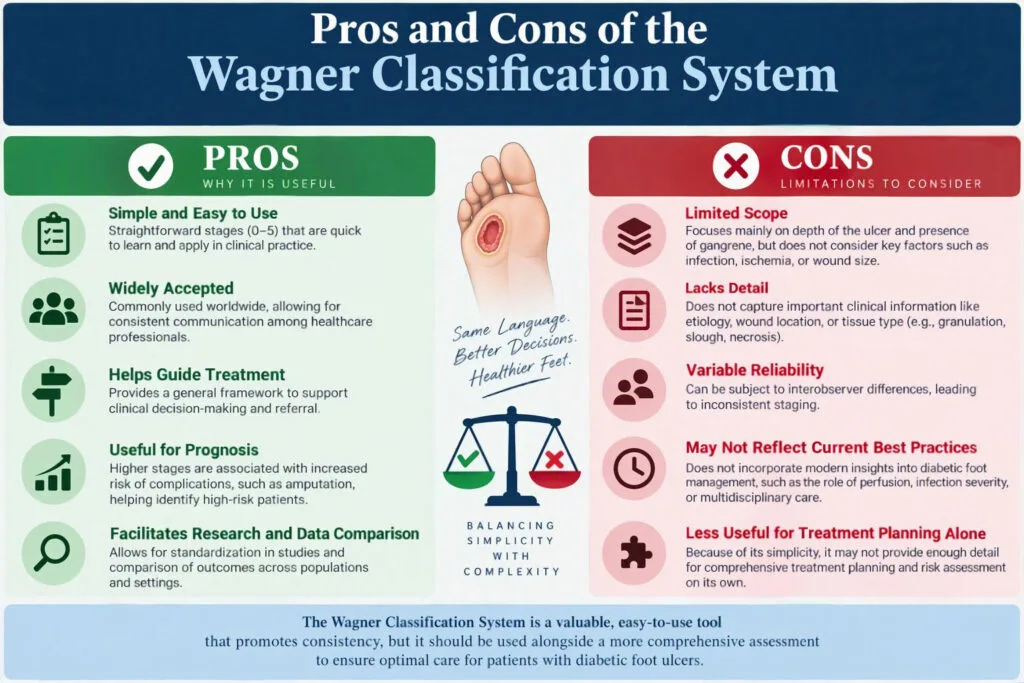
The Wagner classification system grades diabetic foot ulcers from Grade 0 (skin intact but at risk) to Grade 5 (gangrene of the whole foot) based mainly on ulcer depth and tissue death. Its biggest pros are simplicity, speed and decades of clinical use. Its biggest cons are that it barely measures infection and blood supply, and it can group very different wounds into the same grade. That is why modern clinics use it alongside newer systems rather than on its own.
If you or a family member lives with diabetes and has been told “this is a Wagner Grade 2 ulcer,” that number can feel confusing, even frightening. This guide explains what each grade means, where the Wagner system works well, where it falls short, how it compares with newer tools, and what you should do next. It is written by the team at Divyam Reconstructive Diabetic Foot Care Clinic in Visakhapatnam (Vizag), led by Dr. Sumitra Gantayet, a Consultant Reconstructive and Plastic Surgeon with 15+ years of experience in limb salvage
What Is the Wagner Classification System?
The Wagner classification (often called the Wagner–Meggitt classification) is a grading scale for diabetic foot ulcers. It was developed in the early 1980s and remains one of the most recognised systems in the world. Doctors use it to describe how severe a foot wound is, to communicate quickly with other clinicians, and to guide the first decisions about treatment.
The system has six grades, numbered 0 to 5. The first four grades are defined by how deep the ulcer goes. The last two are defined by gangrene, which means dead tissue caused by lack of blood flow.
The six Wagner grades at a glance
| Grade | What it means | Typical features |
|---|---|---|
| 0 | No open wound, but the foot is at high risk | Intact skin, calluses, bony deformity, or a healed ulcer |
| 1 | Superficial ulcer | Wound limited to the skin surface, no deep tissue involved |
| 2 | Deep ulcer | Wound reaches tendon, joint capsule or bone, but no abscess or bone infection |
| 3 | Deep ulcer with infection | Abscess, bone infection (osteomyelitis) or joint infection |
| 4 | Partial gangrene | Dead tissue in part of the foot, such as the toes or forefoot |
| 5 | Extensive gangrene | Dead tissue involving most or all of the foot |
Why grading matters in the first place
A diabetic foot ulcer is not just a “sore that is slow to heal.” Nerve damage (neuropathy) can hide pain, reduced circulation slows repair, and high blood sugar weakens the body’s defences. A small wound can progress to deep infection in days. A grading system gives everyone involved, including surgeon, diabetologist, nurse and patient, a shared language for how serious things are and how fast to act.
A brief history: where the Wagner system came from
Before systems like this existed, doctors described diabetic foot wounds in their own words. “Bad ulcer,” “deep sore” or “infected foot” meant different things to different people, which made it hard to compare patients, share records or judge whether a treatment was working. The Wagner classification, introduced in the early 1980s and built on earlier work by Meggitt, offered a common scale for the first time. It was never meant to be a complete risk calculator. It was designed as a practical way to describe how advanced a foot problem had become, and in that role it succeeded so well that it is still in everyday use more than four decades later.
Understanding that origin helps explain both its strengths (it is easy and universal) and its weaknesses (it was designed before modern tools for assessing infection and blood flow were routine).
Understanding Each Wagner Grade in Detail
The table above gives the short version. Here is what each grade usually looks like in real life, what the care team generally focuses on, and what patients and families should watch for. Remember that these are general descriptions. Your own plan will depend on a full examination.
Wagner Grade 0: The at-risk foot
What it looks like: The skin is intact. There may be thick calluses, corns, bunions, claw toes, a flat or collapsed arch, dry cracked heels, or the scar of a previous ulcer. Many people with Grade 0 feet feel nothing wrong, which is precisely the danger.
What the team focuses on: Prevention. This means checking sensation, examining circulation, identifying high-pressure areas on the sole, treating calluses safely and fitting protective footwear or insoles. Education on daily foot checks is just as important as any treatment.
What to watch for: A callus that suddenly looks darker, feels warm or has a small blister beneath it. This can be bleeding under the skin and an early sign that an ulcer is forming.
Wagner Grade 1: The superficial ulcer
What it looks like: An open sore on the skin that has not gone deeper than the outer layers. It may look like a shallow crater, often on the ball of the foot, the tip of a toe or the heel. There is usually little or no pain because of neuropathy.
What the team focuses on: Removing dead or thickened tissue around the wound, choosing the right dressing, and, most importantly, taking pressure off the area (offloading). Without offloading, even a well-dressed wound often fails to heal because the patient keeps walking on it.
What to watch for: Increasing redness, warmth, swelling, drainage or a bad smell. These suggest infection, and infection is not reflected in the Grade 1 label.
Wagner Grade 2: The deep ulcer
What it looks like: The wound has gone through the skin and fat and can reach tendon, joint capsule or bone. There is no abscess and no bone infection at this stage. The wound may look small on the surface but extend deep beneath it.
What the team focuses on: Careful cleaning and debridement (removal of dead tissue), assessment of blood flow, screening for hidden infection, strict offloading and sometimes imaging such as an X-ray to check the bone. Because deep structures are exposed, timing matters.
What to watch for: Wounds that do not shrink in two to three weeks, new drainage, or pain returning in a foot that was previously numb. These can signal that the wound is moving toward Grade 3.
Wagner Grade 3: The deep ulcer with infection
What it looks like: A deep wound with an abscess (a pocket of pus), infection of the bone (osteomyelitis) or infection of a joint. The foot may be swollen, red and hot, and the person may feel generally unwell or have a fever. In people with diabetes, however, even serious infection can sometimes cause very few symptoms.
What the team focuses on: Urgent assessment and treatment. This often includes drainage of pus, surgical removal of infected tissue or bone, targeted antibiotics based on tissue samples, blood sugar control and careful checks of circulation. Hospital admission is common.
What to watch for: Fever, chills, rapidly spreading redness, severe swelling or a sudden rise in blood sugar. These need same-day medical attention.
Wagner Grade 4: Partial gangrene
What it looks like: Part of the foot, such as one or more toes or the forepart of the foot, has blackened, dried or dead tissue. This usually reflects severely reduced blood supply, often combined with infection.
What the team focuses on: Vascular assessment is critical. The question is whether blood flow can be restored or improved so that the foot can heal. Depending on the findings, treatment may involve procedures to open or bypass blocked arteries, removal of dead tissue, infection control and reconstructive planning to save as much of the foot as possible.
What to watch for: Any black or purple discolouration, cold skin, absent pulses or severe rest pain. Do not wait.
Wagner Grade 5: Extensive gangrene
What it looks like: Gangrene involving most or all of the foot. At this stage the limb is at serious risk, and the patient may be very ill from infection.
What the team focuses on: Emergency stabilisation, urgent decisions about whether any part of the limb can be saved, and, where it cannot, planning the safest and most functional level of amputation. The aim is to protect the patient’s life first and preserve the best possible mobility afterwards.
What to watch for: This is a medical emergency. Prompt care is essential.
The Pros of the Wagner Classification System
Despite being more than 40 years old, the Wagner system is still taught and used for good reasons.
1. It is simple and quick to apply
Wagner grading needs no special equipment. A clinician can assign a grade within minutes of examining the foot. In a busy clinic, in an emergency room, or during a home visit, that speed matters. Patients and families also find a single number easier to understand than a multi-part code.
2. It is universally recognised
Because it has been used for decades, a Wagner grade means the same thing to most doctors across hospitals, cities and countries. If you move between hospitals or seek a second opinion, a Wagner grade in your reports is almost always understood immediately.
3. It reflects wound depth, the most visible danger sign
Depth is one of the strongest visible indicators of risk. A wound that has reached tendon or bone is more dangerous than a surface scrape. The Wagner system puts that idea at the centre of its structure, so it naturally flags deeper wounds as higher priority.
4. It recognises the “at-risk foot” (Grade 0)
Many scoring tools only begin once a wound exists. Wagner Grade 0 reminds everyone that a foot with deformity, calluses or a previous ulcer is already in danger. This supports prevention: regular examination, pressure assessment and protective footwear before an ulcer ever forms.
5. It includes gangrene in the same scale
Grades 4 and 5 bring gangrene into the picture, which signals that circulation has failed and limb-threatening disease is present. This makes the scale useful across the whole journey from a pre-ulcer foot to a limb-threatening emergency.
6. It has a long research record
Decades of studies have used Wagner grades, which means there is a large body of evidence to compare against. Generally, higher grades are linked with longer healing times and a higher risk of amputation, and that pattern has helped clinicians explain risk to patients honestly.
The Cons of the Wagner Classification System
The same simplicity that makes the system popular is also its main weakness. Diabetic foot disease is rarely about depth alone.
1. It does not properly measure infection
Infection is one of the biggest drivers of amputation in diabetes, yet the Wagner system only mentions it at Grade 3, and there it is bundled with abscess, bone infection and joint infection. A superficial ulcer with spreading cellulitis and a fever can be dangerous, but under Wagner it may still be labelled Grade 1. The grade can therefore understate how urgent the situation is.
2. It does not capture blood supply (ischemia) in the early grades
Poor circulation is one of the most important reasons a wound fails to heal. In the Wagner system, circulation only enters the scale when gangrene appears at Grades 4 and 5. Grades 1 to 3 do not tell you whether blood flow is good or poor. Two patients with a “Grade 2” ulcer can have completely different outlooks if one has normal pulses and the other has severe peripheral artery disease.
3. Grade 3 is too broad
Grade 3 includes abscess, osteomyelitis and joint sepsis. These are different problems with different treatments, and they carry different risks. Putting them under one number loses important detail.
4. It ignores neuropathy and other patient factors
Nerve damage, kidney disease, blood sugar control, smoking and previous amputation all influence healing, but none of them are part of the grading. The Wagner grade describes the wound, not the person.
5. It does not tell you how to treat the wound
A grade is a description, not a plan. It does not specify whether the patient needs offloading, antibiotics, revascularisation (restoring blood flow), debridement or reconstructive surgery. Clinicians must still do a full assessment to decide.
6. It does not track healing well
Wagner grading does not include wound size, area or progress over time in a measurable way. A wound can shrink significantly and still stay in the same grade, so it is a blunt tool for monitoring improvement between visits.
7. Grades can be assigned differently by different examiners
Because depth is judged by eye and by probing, two clinicians may disagree on whether a wound is Grade 2 or Grade 3. Newer systems try to reduce this variability with clearer criteria.
A Real-World Illustration: Two Patients, Same Wagner Grade, Very Different Situations
Numbers on paper hide a lot. Consider two hypothetical patients, both told they have a Wagner Grade 2 ulcer on the sole of the foot.
Patient A has a deep ulcer over the ball of the foot. His foot pulses are strong, his foot is warm, there is no redness or discharge, and his blood sugar has been reasonably controlled. With careful debridement, a proper offloading device and regular dressing changes, his wound is likely to improve steadily.
Patient B has an ulcer that looks almost identical. But her foot is cool, her pulses are weak, and she has a long history of smoking. A vascular test shows significantly reduced blood flow. Without treating that circulation problem, her wound is unlikely to heal no matter how good the dressings are, and the risk of it progressing to gangrene is much higher.
Both patients are “Grade 2” in the Wagner system. The label does not distinguish them. This is the single clearest example of why a grade must never be read on its own, and why a thorough assessment of circulation, infection and nerve function is essential.
What a Complete Diabetic Foot Assessment Includes (Beyond the Grade)
Because the Wagner grade covers only part of the picture, a good diabetic foot clinic builds a fuller profile. Here is what that typically involves.
1. Detailed history
The doctor will ask how long you have had diabetes, how well your blood sugar has been controlled, whether you smoke, whether you have had foot ulcers or amputations before, and whether you have kidney, heart or eye complications. These factors strongly influence healing.
2. Wound examination and measurement
The wound is measured, photographed and examined for depth, edges, tissue type, drainage and smell. Gentle probing may be used to check whether the wound reaches bone. Recording the size at each visit is what allows the team to see whether the wound is genuinely improving.
3. Nerve (sensory) testing
Tests such as monofilament testing, vibration testing and reflex checks show how much protective sensation has been lost. A foot that cannot feel pain will not warn you about pressure, injury or infection.
4. Circulation (vascular) assessment
Checking foot pulses, skin temperature and colour is the starting point. Bedside tests and Doppler studies can measure blood flow more precisely. If circulation is poor, a vascular specialist may be needed before or alongside wound treatment.
5. Plantar pressure assessment
Mapping where pressure falls on the sole shows which areas are at risk of ulceration. This guides the design of insoles, footwear and offloading strategies.
6. Infection assessment
Signs of infection are checked clinically. Blood tests, wound or tissue cultures and imaging may be used to find out whether bone or deeper structures are involved and which antibiotics are appropriate.
7. Imaging
An X-ray can show bone changes, deformities, gas in the tissues or signs of bone infection. Further imaging may be advised in complex cases.
8. Blood tests and overall health
Blood sugar control, kidney function, haemoglobin and nutrition status all affect healing and are reviewed as part of a complete plan.
Taken together, these findings, plus the Wagner grade, give the team a much more reliable picture than the grade alone.
Wagner vs Newer Diabetic Foot Classification Systems
Several other systems were created to fill the gaps above. Most specialists now see Wagner as a useful starting point and use one or more of these alongside it.
| System | What it adds | Best used for |
|---|---|---|
| Wagner | Depth plus gangrene, six simple grades | Quick communication and basic severity |
| University of Texas (UT) | Depth (0–3) combined with stage (A–D) for infection and ischemia | More detailed risk and outcome prediction |
| SINBAD | Scores site, ischemia, neuropathy, bacterial infection, area and depth | Audit, research and comparing clinics |
| WIfI (Wound, Ischemia, foot Infection) | Grades wound, ischemia and infection separately | Estimating amputation risk and the benefit of revascularisation |
| IDSA / IWGDF infection grading | Detailed severity scale for diabetic foot infection | Deciding antibiotics and hospital admission |
Is any one system “the best”?
No single classification is perfect for every situation. International guideline groups recommend choosing a system that your team uses consistently, and combining it with a proper assessment of infection and circulation. In practice, a well-run diabetic foot clinic will record the Wagner grade for quick reference while also documenting infection status, pulses or vascular test results, nerve function and wound measurements.
How Wagner Grades Guide Treatment (In General Terms)
Every patient is different, and treatment is decided after a full examination. In general terms, though, the grade gives a rough idea of what level of care may be needed.
Grade 0: Prevention and protection
The focus is on protecting the foot before a wound forms. This usually includes a foot examination, sensory testing, plantar pressure assessment, callus care, proper footwear and patient education.
Grades 1–2: Active wound care and offloading
Superficial and deep ulcers without abscess usually need careful cleaning and removal of dead tissue, appropriate dressings, and offloading, which means taking pressure off the wound. Blood flow and infection must still be checked, because they decide whether the wound will heal.
Grade 3: Infection control and often surgery
An abscess or bone infection typically needs urgent evaluation, drainage or removal of infected tissue, targeted antibiotics and close monitoring. Delay here is risky.
Grades 4–5: Limb-threatening emergencies
Gangrene needs immediate specialist assessment. Teams look at circulation, infection and the extent of tissue loss to decide whether the limb can be saved, and what reconstructive or vascular procedures may help. The goal at every stage is to preserve as much of the foot and as much mobility as possible.
The Role of Reconstructive Surgery and Limb Salvage
Many patients and families assume that a high Wagner grade means the only option is amputation. In reality, the field of limb salvage has moved a long way. A reconstructive and plastic surgeon works to save the foot and keep the patient walking, using techniques such as:
- Debridement and wound bed preparation to remove dead and infected tissue and create conditions in which healing can occur.
- Offloading surgeries that correct the bony or soft-tissue causes of high pressure, such as tight tendons or prominent bones, so the ulcer does not keep returning.
- Reconstruction of deformities, including those caused by Charcot changes, to give a foot that can bear weight and fit into protective footwear.
- Soft tissue coverage using local flaps or grafts to close wounds that will not heal on their own.
- Coordination with vascular teams so that blood flow is improved where needed.
- Advanced wound therapies, such as topical oxygen therapy, which may support healing of chronic wounds in selected patients.
- Structured post-operative care, including follow-up visits, offloading, dressings and footwear, which is as important as the operation itself.
The right approach depends on the individual. What matters is that the decision is made by a team experienced in diabetic limb salvage, early, and with a clear understanding of the whole foot rather than the grade alone.
Common Myths About Diabetic Foot Ulcer Grading
Myth 1: “If it doesn’t hurt, it isn’t serious.” Because of neuropathy, even deep or infected wounds can be painless. Pain is not a reliable guide in diabetes.
Myth 2: “A low grade means I can wait and see.” Grade 1 wounds can become deep and infected quickly, especially when circulation is poor or the foot keeps taking weight. Early treatment gives the best chance of a simple recovery.
Myth 3: “A high grade means my foot is lost.” A higher grade means higher risk, not a fixed outcome. Many patients with advanced problems keep their feet through timely, specialised care.
Myth 4: “The grade is permanent.” Grades describe the wound at a point in time. A wound can improve, and a foot can return to Grade 0 once it has healed, although it then remains at high risk of recurrence and needs lifelong protection.
Myth 5: “Home remedies and antiseptic creams are enough.” Wounds in diabetic feet need professional cleaning, pressure relief and monitoring. Unproven home treatments can delay care and allow infection to spread.
Myth 6: “Once the ulcer heals, I’m done.” A healed ulcer is one of the strongest predictors of another. Prevention, footwear and regular follow-up continue long after the skin closes.
Questions to Ask Your Doctor About Your Wagner Grade
If you have been given a grade, these questions can help you understand your situation and take part in decisions:
- What Wagner grade is my wound, and how did you decide on it?
- Is there any sign of infection, and has the bone been checked?
- How is the blood flow to my foot, and do I need a circulation test?
- How much nerve damage do I have?
- What is the plan for taking pressure off the wound, and for how long?
- How often should the dressing be changed and by whom?
- How will we know if the wound is improving, and when will you re-measure it?
- Which warning signs mean I should come in immediately?
- Would surgery help, and what are the options?
- What footwear should I use once it heals, and how do I stop it coming back?
Tips for Family Members and Caregivers
Many people with diabetic foot problems rely on relatives for daily support. If you are caring for someone, you can help in practical ways:
- Check their feet daily if they cannot see or reach them, and look between the toes and under the heel.
- Keep appointments and bring all reports, including previous Wagner grades, tests and medicine lists.
- Make sure dressings and offloading devices are used exactly as advised, and that your family member is not walking barefoot at home.
- Watch for changes in behaviour or blood sugar, since a sudden rise or unusual drowsiness can be a sign of infection.
- Encourage and support healthy habits, including balanced meals, medicine on time, not smoking and gentle activity as approved by the doctor.
- Do not delay. If something looks worse, call the clinic rather than waiting for the next scheduled visit.
When Should You Worry? Signs Not to Ignore
Do not wait for a wound to reach a high grade before seeking help. See a diabetic foot specialist promptly if you notice any of these:
- A wound that has not improved in two to three weeks
- Redness, warmth, swelling or pus around a sore
- A bad smell or discharge from a wound
- Skin turning black, blue or very pale
- Cold feet, or colour changes in the toes
- Numbness, tingling or loss of feeling
- A callus with dark discolouration beneath it
- Fever or feeling generally unwell together with a foot wound
Any of these signs can mean the wound is more serious than it looks on the surface, which is exactly where a simple grade can mislead.
How to Lower Your Risk of Moving Up the Grades
Most advanced diabetic foot problems are preventable or can be caught early. These habits make the biggest difference:
- Inspect your feet every day. Use a mirror or ask a family member to check the soles and between the toes.
- Never walk barefoot, even at home.
- Wear well-fitting footwear with no pressure points, and check inside shoes before wearing them.
- Keep blood sugar under control, as advised by your diabetes doctor.
- Do not cut calluses or corns yourself. Let a professional do it.
- Stop smoking, because it damages circulation.
- Book regular foot examinations, including sensation and circulation checks, even if nothing hurts.
FAQs
1. What does Wagner Grade 2 mean?
Wagner Grade 2 means the ulcer is deep and reaches structures such as tendon, joint capsule or bone, but there is no abscess or bone infection yet. It needs prompt professional care because deeper wounds can progress quickly, especially if circulation is poor or infection develops.
2. Is the Wagner classification still used today?
Yes. It is still widely taught and used because it is simple and familiar. However, many specialists now pair it with systems such as the University of Texas classification, SINBAD or WIfI to capture infection and circulation more accurately.
3. Does a higher Wagner grade always mean amputation?
No. A higher grade generally means a higher risk, but it does not make amputation inevitable. Outcomes depend on blood supply, infection control, the patient’s overall health and how quickly expert treatment begins. Many limbs are saved through timely care, offloading, vascular treatment and reconstructive surgery.
4. What is the main limitation of the Wagner classification?
Its main limitation is that it does not assess infection and ischemia (poor blood flow) in a detailed way, especially in Grades 1 to 3. Both factors strongly affect healing, so a Wagner grade alone cannot predict how a wound will behave.
5. Can a diabetic foot ulcer be treated at Grade 1 or Grade 2 without surgery?
Many Grade 1 and some Grade 2 ulcers heal with proper wound care, infection control and offloading, provided circulation is adequate. Whether surgery is needed is decided after a full assessment of the wound, blood flow and foot structure.
Take the Next Step: Get Your Foot Assessed in Vizag
A grade on paper is only the beginning. What matters is a complete assessment of your wound, infection status, circulation, nerve function and foot structure, followed by a clear plan.
At Divyam – Reconstructive Diabetic Foot Care Clinic, Dr. Sumitra Gantayet (MBBS, DNB; member of APSI and DFSI) and her team have treated 5,000+ patients with diabetic foot problems, offering wound care, infection control, vascular and plantar pressure assessment, offloading and reconstructive surgery, with a strong focus on preventing amputations.
📍 Clinic: 2nd Floor, Coastal One, Plot No 1, Balaji Nagar, Siripuram, Visakhapatnam – 530003 📞 Call: +91 88867 35004 🚨 Emergency support: Available 24/7