
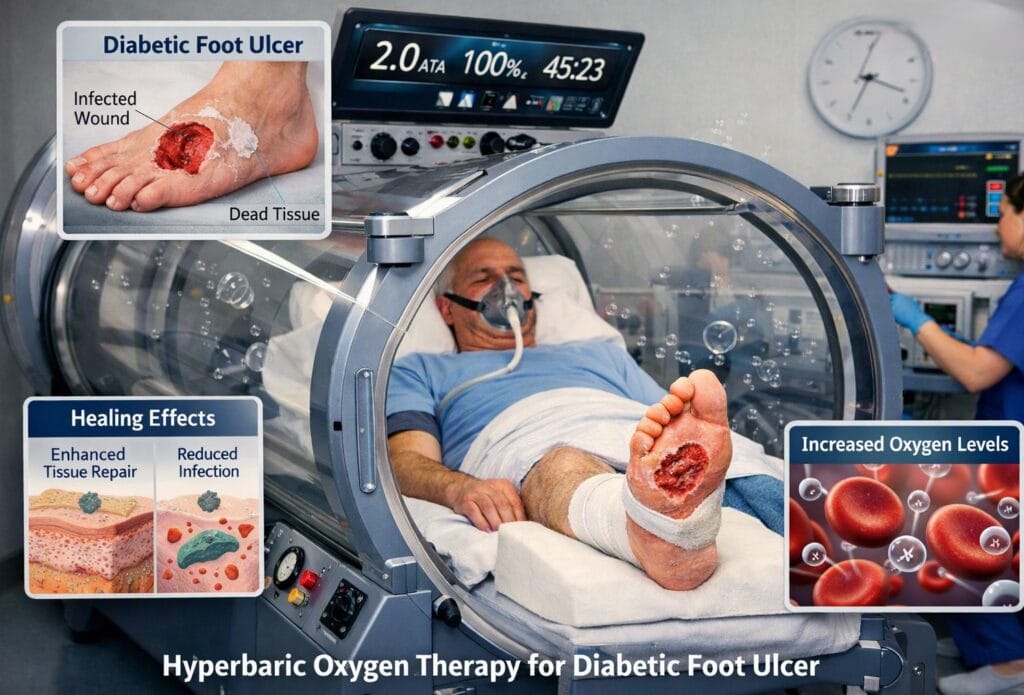
Hyperbaric oxygen therapy (HBOT) can help certain diabetic foot ulcers heal, but it is not a cure-all. Several meta-analyses of clinical trials show higher healing rates and fewer major amputations when HBOT is added to standard wound care. International guidelines, however, recommend it only as an add-on, and only for selected patients: usually those with ischaemic or deep ulcers that have not improved despite good standard treatment. For a shallow, purely nerve-related ulcer, offloading and expert wound care matter far more.
If you or a family member has a foot wound that is not healing, this guide explains how HBOT works, what the evidence really says, who is a realistic candidate, and what to do first.
What Is Hyperbaric Oxygen Therapy?
Hyperbaric oxygen therapy means breathing 100% oxygen inside a sealed chamber where the air pressure is raised above normal. Sessions typically last around 90 minutes and are repeated daily over several weeks.
Why extra oxygen matters for a wound
Healing is hard work for the body. New blood vessels, collagen and skin cells all need oxygen. In a chronic diabetic foot ulcer, narrowed arteries and damaged small vessels often leave the wound tissue starved of oxygen. When the wound stays hypoxic, healing stalls and bacteria gain the upper hand.
Under pressure, far more oxygen dissolves directly in the blood plasma. That oxygen can reach tissue that red blood cells struggle to supply. Researchers believe this supports new blood vessel growth, helps white blood cells fight infection, and encourages tissue repair.
How HBOT may help a wound heal
Researchers point to several effects. Not all of them have been proven in people with diabetic ulcers, but together they explain why the therapy is studied:
- More oxygen reaches the wound. Breathing pure oxygen under pressure raises the amount dissolved in the blood plasma many times over, so tissue that red blood cells cannot supply well may still receive oxygen.
- New blood vessel growth. Repeated sessions are thought to stimulate the growth of small new vessels (angiogenesis) at the wound edge.
- Better infection defence. White blood cells use oxygen to kill bacteria. High oxygen levels may also make the wound environment harder for some bacteria, particularly those that thrive without oxygen.
- Less swelling. Reduced tissue swelling may improve blood flow through the smallest vessels.
- Stronger repair activity. Fibroblasts, the cells that lay down collagen, work better when oxygen is available.
One point is easy to miss: HBOT does not open blocked arteries. If a major artery in the leg is narrowed, restoring blood flow through angioplasty or bypass usually comes first, and HBOT is considered alongside that treatment, not instead of it.
HBOT vs. topical oxygen
These are two different treatments. In HBOT, you breathe oxygen in a chamber and the whole body is treated. Topical oxygen delivers oxygen directly onto the wound surface, usually with a portable device. The 2023 international guideline supports both in selected cases, and neither replaces basic wound care.
Does Hyperbaric Oxygen Therapy Work for Diabetic Foot Ulcers?
The honest answer is “it can, for the right patient.” Here is what the research shows.
What the meta-analyses found
- A 2022 meta-analysis in the Asian Journal of Surgery, covering 20 randomised trials, found HBOT increased healing rates, shortened healing time, and reduced major amputations.
- A 2023 review in International Wound Journal, limited to seven randomised trials, concluded HBOT promotes complete healing of diabetic foot ulcers while remaining safe as an add-on to standard care.
- A review of 14 randomised trials sorted by Wagner grade found moderate-quality evidence of better healing for Wagner grades II to IV, and fewer amputations in more severe cases.
- A 2024 network meta-analysis of 34 studies (2,268 patients) ranked HBOT highest among gas-based therapies for healing, and found better outcomes when treatment ran longer than six weeks.
Why experts are still cautious
The research is encouraging, but it has limits. Many trials were small, patients and treatments differed from study to study, and some earlier trials could not hide from patients whether they were receiving real treatment. The same network analysis also flagged a possible increase in amputation risk, which shows how unsettled some outcomes still are. The largest trial in ischaemic diabetic wounds (120 patients) added to a mixed picture overall.
That is why the guideline wording is careful.
What the guidelines say
The International Working Group on the Diabetic Foot (IWGDF) 2023 guideline advises clinicians to consider hyperbaric oxygen as an adjunct in neuro-ischaemic or ischaemic ulcers where standard care has failed and where resources already exist. It is rated a conditional recommendation based on low-certainty evidence.
In plain terms: HBOT is an option after the basics have been done properly, not a first-line treatment.
Why Studies on HBOT Do Not Always Agree
If you read around, you will find strong claims on both sides. That is not because someone is hiding the truth. Trials simply differ in ways that change the result.
1. Different types of ulcers were studied
Some trials enrolled ulcers of any depth, including shallow wounds that were likely to heal anyway. Others enrolled only ischaemic or deeper ulcers. When shallow ulcers dilute the sample, any benefit looks smaller. A US wound registry report noted that in one large analysis finding no benefit, about 60% of the ulcers treated were Wagner grade 2, which falls outside typical coverage criteria. The authors suggested that poor patient selection likely contributed to that disappointing result.
2. Treatment protocols varied
Studies used different numbers of sessions, pressures and session lengths. The 2024 network meta-analysis found better outcomes when treatment lasted longer than six weeks, which suggests that stopping too early may undersell the therapy.
3. Outcomes were measured at different times
Some trials counted healing at 12 weeks. Others followed patients for a year. A treatment can look unimpressive at three months and better at twelve, or the reverse.
4. Blinding is hard
In drug trials, patients do not know whether they received the real medicine. In HBOT, building a convincing “sham” chamber is difficult, so some studies could not fully hide the treatment from patients or staff.
5. Standard care was not equal everywhere
Trials run in specialised diabetic foot centres delivered excellent baseline care. In centres with weaker offloading or debridement, the added effect of oxygen may differ.
What this means for you
| Question | What the research broadly suggests |
|---|---|
| Does HBOT help any diabetic foot ulcer? | Not reliably. Benefit is clearest in selected deeper or ischaemic ulcers. |
| Does it replace standard care? | No. It is only ever an add-on. |
| Is longer treatment better? | One analysis found better results beyond six weeks, but protocols still need standardising. |
| Is the evidence settled? | No. Guidelines rate it conditional and low-certainty, and call for better trials. |
The practical lesson: choosing the right patient matters as much as choosing the therapy.
Who Is a Good Candidate for HBOT?
HBOT is not for every ulcer. Specialists generally look at the following.
Ulcers that may qualify
- Deeper ulcers: Many coverage policies use Wagner grade 3 or higher, meaning a deep ulcer with abscess or bone infection, or gangrene of part of the foot.
- Ischaemic or neuro-ischaemic ulcers: Wounds where poor blood supply is a major reason for non-healing.
- Stalled wounds: Insurance and clinical criteria commonly ask for no significant improvement after 30 days of standard treatment.
Ulcers that usually do not need it
Most superficial, purely neuropathic ulcers heal with proper offloading, debridement, infection control and blood sugar management. Specialists note that these patients are generally not candidates for HBOT, and clinical guidance advises avoiding it in Wagner grade 2 or lower ulcers.
The foundations come first
Oxygen therapy only helps when the basics are in place:
- Blood flow assessment and revascularisation if arteries are blocked
- Sharp debridement of dead tissue and callus
- Offloading so the wound is not pressed on while walking
- Infection control, including antibiotics and bone infection management
- Blood sugar control
If any of these is missing, HBOT is unlikely to rescue the wound.
How doctors judge whether an ulcer is responding
Before and during HBOT, your team should track the wound objectively, not by impression.
- Measurement and photographs at every visit. Length, width, depth and photos allow real comparison from week to week.
- A commonly used benchmark: an ulcer that has not shrunk by roughly half after about four weeks of good standard care is less likely to heal on schedule, which is a signal to look again at circulation, infection, bone involvement and offloading.
- Circulation tests. Depending on the centre, these can include ankle and toe pressures, Doppler studies, or skin oxygen measurements (TcPO2) around the wound. These tests help show whether poor blood supply is a major barrier.
- Ongoing review during HBOT. Many policies re-evaluate after every 15 sessions or every 30 days. Some insurers require a minimum reduction in wound area at each 30-day check (one policy cites at least 20%) before approving more sessions.
- A stop rule. If the wound shows no measurable progress, treatment should be reviewed, not continued indefinitely.
Ask your clinic what measurements they will use and when they will decide whether to continue.
What to Expect During HBOT
Before treatment
Your care team reviews your wound, circulation, lungs, ears and sinuses, and current medicines. Blood sugar is checked, because oxygen under pressure can occasionally affect glucose levels. Metal, lighters, oil-based products and electronics are not allowed in the chamber because of fire risk.
During a session
You lie or sit comfortably in the chamber while pressure slowly rises. You may feel your ears “pop”, like descending in an aircraft. You breathe oxygen for most of the session, and staff monitor you throughout.
How many sessions?
Courses are commonly given daily, five days a week, across several weeks. The wound is measured regularly, often around every 15 treatments or every 30 days. If measurable healing is not happening, treatment is usually reviewed or stopped.
Risks and Side Effects
HBOT is generally well tolerated when delivered by trained staff, but it is not risk-free.
Common effects
- Ear pressure or discomfort (barotrauma)
- Sinus pain
- Temporary blurred or shortsighted vision, which usually settles after treatment ends
- Tiredness
- Claustrophobia in some people
Rare but serious risks
- Oxygen toxicity affecting the lungs or, very rarely, causing seizures
- Fire in the chamber if safety rules are broken
- Lung injury in people with certain lung conditions. Some conditions, such as an untreated collapsed lung, rule HBOT out.
Low blood sugar
People on insulin or sugar-lowering tablets should have glucose monitored around sessions.
Tell your doctor about any lung disease, ear problems, cancer treatment history, pregnancy, or claustrophobia before you begin.
Is HBOT Worth It? Access, and Alternatives
Access
HBOT needs a specialised chamber and trained team, and it is not available everywhere. Costs and insurance coverage vary widely by hospital and by insurer. In several countries, coverage rules mirror clinical criteria, such as Wagner grade 3 or higher and a failed 30-day trial of standard care. Always ask your insurer for current rules before starting.
Other options for hard-to-heal ulcers
HBOT is one of several add-on therapies. Depending on your wound, your specialist may consider:
- Revascularisation (angioplasty or bypass) when arteries are blocked
- Advanced dressings, such as sucrose octasulfate dressings
- Negative pressure wound therapy, particularly after surgery
- Topical oxygen therapy
- Surgical reconstruction to remove infected bone or correct deformity
How the main options compare
| Option | What it does | Best suited for | Main limitation |
|---|---|---|---|
| Offloading (total contact cast, boot, specialised footwear) | Takes pressure off the ulcer | Almost every plantar ulcer | Needs daily discipline |
| Sharp debridement | Removes dead tissue and callus | Almost every ulcer | Needs a trained clinician, repeated visits |
| Revascularisation | Restores blood flow to the leg | Ulcers with significant artery disease | Needs vascular assessment, not suitable for all |
| Hyperbaric oxygen (HBOT) | Raises oxygen delivery to tissue | Selected ischaemic or deeper, stalled ulcers | Limited access, daily sessions, low-certainty evidence |
| Topical oxygen | Delivers oxygen to the wound surface | Selected stubborn ulcers | Newer evidence, device availability |
| Negative pressure wound therapy | Applies suction to promote healing | Post-surgical wounds | Not for untreated infection or dead tissue |
| Surgical reconstruction | Removes infected bone, corrects deformity | Bone infection, structural problems | Surgery and recovery time |
How to Get the Most Out of Treatment
HBOT only works inside a wider plan. Whatever the chamber does, these daily habits decide how far the wound can heal.
Keep blood sugar steady
High glucose weakens white blood cells and slows repair. Check your sugar as your doctor advises, take medicines on schedule, and tell the team about any lows, since sugar can shift around chamber sessions.
Stop smoking and avoid tobacco
Smoking narrows blood vessels and cuts oxygen delivery, which works against the very thing HBOT is trying to improve. Most centres also require you to stop smoking, and chambers have strict fire-safety rules about nicotine and lighters.
Eat enough protein and stay nourished
Wound repair needs protein, calories, vitamins and minerals. Ask your clinician or dietitian for a plan that fits your diabetes and kidney health, instead of cutting food drastically to control sugar.
Keep offloading, even on “good” days
It is tempting to walk normally once the wound looks better. Pressure on a healing ulcer can undo weeks of progress. Wear the prescribed boot, cast or footwear whenever you stand or walk, including indoors.
Keep dressings and visits on schedule
Follow your wound care schedule exactly. Report any new redness, swelling, odour, drainage or fever the same day.
Check both feet every day
Look at the other foot too, including between the toes and the heel. Use a mirror or ask a family member if you cannot see the sole.
Plan for after healing
Healing is not the finish line. Ulcers often come back: commonly cited figures put recurrence at around four in ten within a year. Protective footwear, regular podiatry, daily checks and good glucose control lower that risk.
HBOT Myths and Facts
| Myth | Fact |
|---|---|
| “HBOT is a guaranteed cure for diabetic foot ulcers.” | It helps some selected ulcers, not all. Evidence quality is moderate to low. |
| “Anyone with a foot ulcer should get it.” | Guidelines limit it to specific ulcers that have failed good standard care. |
| “If I have HBOT, I do not need offloading or dressings.” | HBOT is an add-on. Standard wound care remains essential. |
| “It is painful.” | The session is not painful. Ear pressure is the most common discomfort and can usually be managed. |
| “It unblocks my arteries.” | It does not. Blocked arteries may need a separate procedure. |
| “More sessions always means better results.” | Sessions should continue only while the wound shows progress. |
| “It is only for people who are about to lose a limb.” | It is usually considered for limb-threatening ulcers, but the aim is to help healing earlier, not to wait for the last resort. |
Why Early Specialist Care Matters More Than Any Single Therapy
The best predictor of a good outcome is not a machine. It is how early the ulcer reaches a team that treats the whole problem: circulation, infection, pressure, and glucose together.
Warning signs that you should not wait on:
- A wound that has not shrunk after 2 to 4 weeks
- Redness, swelling, warmth or pus
- Foul smell or drainage
- Black or blue-grey skin
- New pain, or loss of feeling
- Fever or feeling generally unwell
See our guide to diabetic foot ulcer warning signs (internal link) for a full checklist.
Questions to Ask Your Doctor Before Starting HBOT
Bring this list to your appointment. Clear answers are a good sign that the plan is sound.
- What type and grade is my ulcer, and why do you think HBOT could help?
- Has my circulation been tested, and do I need a vascular procedure first?
- Is there any bone infection, and how is it being treated?
- What standard care have I had so far, and was offloading fully effective?
- How many sessions are planned, and how will you decide whether to continue?
- What is the total cost, and what does my insurance or scheme cover?
- What risks apply to me given my lungs, ears, eyes and medicines?
- What happens if the wound does not improve? What is the backup plan?
- Who will supervise the sessions, and what safety checks are in place?
FAQs
1. Does hyperbaric oxygen therapy really heal diabetic foot ulcers?
It can help selected ulcers heal as an add-on to standard care. Meta-analyses report higher healing rates and fewer major amputations, though evidence quality is moderate to low and results vary. It works best for ischaemic or deeper ulcers that have stalled despite good treatment.
2. How many HBOT sessions are needed for a diabetic foot ulcer?
Courses usually run daily over several weeks, with sessions of around 90 minutes. Your specialist will measure the wound regularly and decide whether to continue. One analysis found better results when treatment lasted longer than six weeks.
3. Is HBOT safe for people with diabetes?
For most people, yes, under medical supervision. Side effects such as ear pressure and temporary vision changes are usually mild. Blood sugar should be monitored because it can shift during treatment, and some lung conditions make HBOT unsafe.
4. Who should not have hyperbaric oxygen therapy?
People with certain untreated lung conditions, a collapsed lung, or severe uncontrolled ear or sinus problems may be advised against it. Anyone with a superficial, purely neuropathic ulcer is unlikely to need it. Your doctor will review your history first.
5. What should I try before HBOT?
Make sure your circulation has been checked, the wound is properly debrided, pressure is fully offloaded, infection is treated, and blood sugar is controlled. HBOT is considered when a wound has not improved despite these steps.
6. How soon will I see results from HBOT?
Healing is gradual. Many specialists look for measurable shrinkage over the first several weeks, and wounds are reviewed around every 15 sessions or 30 days. If there is no measurable progress, the plan should be re-examined.
7. Is HBOT painful?
No, the oxygen itself is not painful. The most common discomfort is ear pressure as the chamber pressurises, similar to descending in an aircraft. Staff can teach you ways to equalise the pressure.
8. Can HBOT replace antibiotics or surgery?
No. Infection needs appropriate antibiotics, and infected bone or dead tissue often needs surgical removal. HBOT may be added, but it does not substitute for these treatments.
9. Is HBOT used for bone infection (osteomyelitis) in diabetic feet?
It is sometimes used as an adjunct in selected chronic bone infections that do not respond to standard treatment, but the 2023 international guideline did not find clear evidence supporting it for diabetic foot infections generally. Antibiotics and surgery remain the foundation.
10. What happens if HBOT does not work?
Your team should reassess the whole picture: circulation, hidden infection, pressure on the wound, nutrition and glucose. Other options may include revascularisation, surgery, advanced dressings or topical oxygen.
11. Can I have HBOT if my ulcer is shallow and on the sole of my foot?
Usually this type of ulcer heals with offloading, debridement and good care, and clinical guidance advises avoiding HBOT for Wagner grade 2 or lower. Your doctor can confirm after examining the wound.
Get an Expert Opinion on Your Foot Ulcer
A wound that will not heal needs a clear plan, not guesswork. At RDFC (Divyam Reconstructive Diabetic Foot Care Clinic) in Visakhapatnam (Vizag), our team led by Dr. Sumitra Gantayet assesses circulation, infection, pressure and healing progress, and explains which treatments are worth considering for your ulcer, including whether oxygen therapy may be appropriate.